
Ultra-compact 20.0 × 10.0 mm sensor fusing 6-DoF motion sensing (up to 6.66 kHz ODR) with wideband digital PDM acoustic MEMS, dual-core RISC-V SoC micro-DSP, fixed-point 4096-pt FFT, ISO 20816 velocity RMS, and half-duplex RS-485 Modbus RTU communication.
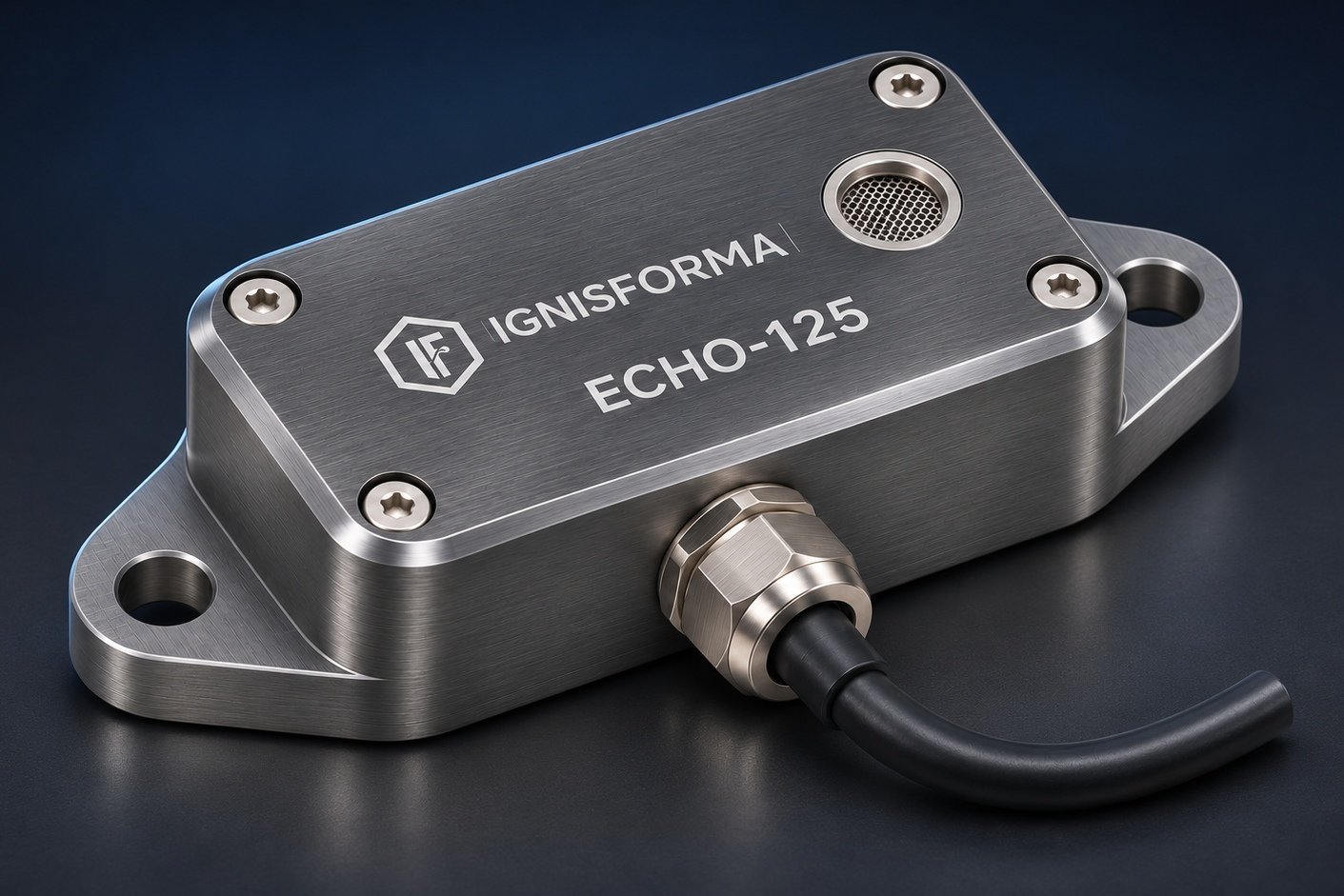
Engineered for embedded mechanical intelligence: fusing wideband high-frequency inertial motion, airborne & structure-borne acoustic capture, and hardware-accelerated DSP in an ultra-low-mass profile.
Comprehensive hardware parameters, processing benchmarks, physical dimensions, and electrical operating limits.
| Feature | Specification (target) |
|---|---|
| Form factor | 20.0 × 10.0 mm, 1.6 mm 4-layer FR-4; components top + IMU bottom; ≈ 1.0 g |
| Motion sensing | 3-axis accel ±2/4/8/16 g + 3-axis gyro ±125…±2000 dps, ODR to 6.66 kHz |
| Acoustic sensing | Digital PDM MEMS microphone, 100 Hz – 10 kHz, −26 dBFS sensitivity* |
| Processor | Dual-Core RISC-V SoC: 160 MHz HP core + 20 MHz LP core, 512 KB HP SRAM, in-package 4 MB flash (Optional BLE*) |
| Edge analytics | RMS / peak / crest / kurtosis, velocity RMS (ISO 20816), fixed-point FFT to 4096 pts, envelope demodulation, SPL dB(A), octave bands, tilt, on-MCU anomaly score |
| Interface | RS-485 half-duplex (Modbus RTU, 9.6 kbaud – 2 Mbaud) or 3.3 V TTL UART; raw-data streaming mode |
| Power | 3.3 / 5 V DC (3.0 – 5 V) on pad P1; ≈ 30 mA typ, ≈ 70 mA during RS-485 transmit |
| Environment | −40 °C to +85 °C operating |
| Installation | Rigid epoxy via 1.0 mm bond frame (IMU never in adhesive); +Z normal to mounting face |
* Note on Acoustic Sensing: Standard wideband acoustic sensing covers 100 Hz – 10 kHz. Application-specific transducer options are available upon engineering evaluation.
** Note: Optional BLE wireless capability available in designated hardware variant. Target specifications; subject to change after validation.
The dual-core RISC-V SoC eliminates raw-data cloud bottlenecks by running synchronous micro-DSP pipelines directly at the physical point of measurement.
Continuously integrates acceleration waveforms to compute velocity RMS in accordance with the ISO 20816 method, allowing direct classification into machine health zones (Class I – IV) without PLC computational load.
Hardware-accelerated fixed-point FFT up to 4096 points isolates distinct mechanical frequencies, running alongside envelope demodulation to reveal bearing defect harmonics (BPFO, BPFI, BSF, FTF).
Extracts true Peak, RMS, Crest Factor, Kurtosis, and static/dynamic tilt angle. Kurtosis and crest factor identify early-stage impact events well before overall vibration levels breach warning thresholds.
Calculates Sound Pressure Level (SPL) in dB(A) and decomposes acoustic energy across octave bands (100 Hz – 10 kHz wideband acoustic). A real-time on-MCU anomaly score fuses motion and acoustic indicators for deterministic local alerting.
With a nominal footprint of only 20.0 × 10.0 mm and mass of ≈ 1.0 g, IGFO-AE-100 embeds directly into tight mechanical enclosures where conventional sensors cannot fit.
Direct embedding into robot arm castings, wrist assemblies, and harmonic gearboxes. The nominal 1.0 g mass introduces virtually zero inertia or dynamic unbalance. Synchronous 6-DoF motion tracking at 6.66 kHz ODR monitors gear backlash, joint tooth friction, and micro-oscillations.
Mounted via rigid epoxy directly onto the spindle cartridge or nose bearing cap. The combination of 6.66 kHz vibration ODR and 4096-pt FFT captures high-frequency tool chatter, cutter imbalance, and outer-race bearing spalling to support early intervention.
The digital PDM MEMS microphone captures airborne turbulence and structure-borne acoustic hiss from compressed air fittings, process steam traps, and vacuum valves. Octave-band energy and SPL dB(A) metrics pinpoint micro-leaks and cavitation bubbles before hydraulic pump wear occurs.
Sub-miniature size permits installation inside atmospheric transfer modules, EFEM end-effectors, and turbomolecular pump housings. Modbus RTU communication over multi-drop RS-485 connects directly into tool PLCs without introducing extra bulk inside high-cleanliness environments.
Built for −40 °C to +85 °C industrial temperature extremes and 3.0 – 5 V supply tolerances. Ideal for tracking hydraulic drive motors, planetary hub gearboxes, and vibrating screener decks where shock, vibration, and dust would destroy consumer-grade sensors.
Surface-mounted to motor bearing housings and pump casings. Provides standard ISO 20816 velocity RMS alongside envelope demodulation and acoustic friction metrics, offering complete mechanical condition monitoring in a package the size of a postage stamp.
Carefully designed physical mounting protocols and electrical termination details ensure maximum mechanical coupling fidelity and long-term operating reliability.
The sensor is secured to monitored mechanical surfaces using rigid industrial epoxy across a 1.0 mm bond frame.
All power and communications connect through high-reliability solder pads on Pad P1:
| Signal | Pin / Pad | Description |
|---|---|---|
| VCC | P1-1 | 3.3 V / 5.0 V DC (3.0 – 5 V allowed) |
| GND | P1-2 | Power Ground & Shield Reference |
| RS-485 A (+) | P1-3 | Non-inverting Modbus differential line |
| RS-485 B (−) | P1-4 | Inverting Modbus differential line |
| UART TX / RX | P1-5 / 6 | 3.3 V TTL UART raw-data streaming |
Connect with our engineering team to review mechanical drawings, evaluate pre-production samples, or configure custom Modbus register mappings for your machine tool or robotic architecture.